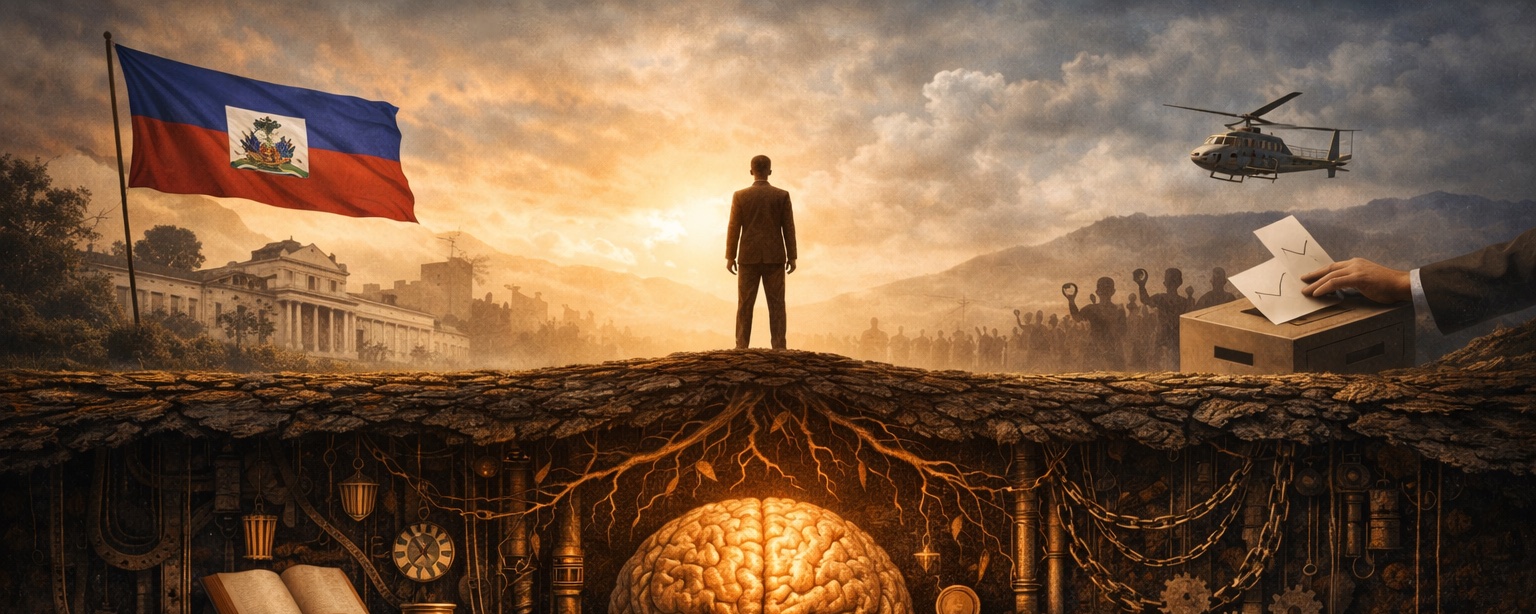
The Machinery Beneath Choice: Knowledge, Experience, and Consciousness in the Building of Nations
Ralf S. Rho
There are moments in the life of a people when the crisis before them is misnamed. They speak of insecurity, collapsing economies, broken institutions, and the choreography of power. They debate constitutions, elections, and foreign pressures as though history were decided only in public view. Yet beneath the visible turbulence, another reality moves silent, patient, decisive.
Nations do not first collapse in their streets. They collapse in the quality of mind entrusted to guide them. And when renewal finally arrives, it does not begin with policy. It begins in a place history rarely records: the invisible machinery beneath human choice.
The Invisible Architecture of Decision
Every decision made by a leader appears immediate; a decree signed, a command issued, a negotiation accepted or refused. Yet no decision is born solely in the present moment. Each carries an unseen ancestry: memory, fear, humiliation, survival instinct, pride, hope, and unfinished wounds. What feels like conscious choice is often the subconscious completing a sentence the past has already begun.
Leadership, therefore, is never merely administrative. It is psychological. Moral. Spiritual. To understand why nations, stagnate or rise, one must look beyond institutions into the inner formation of those who govern. There we encounter a pattern both simple and devastating: power exercised without knowledge, without experience, and without consciousness. This triad of absence is not merely weakness; it is the hidden engine of historical repetition.
What Programs the Subconscious of Power
Long before knowledge is studied or experience earned, the mind of a future leader is already being shaped. Four forces quietly form the automatic self that later governs nations: early survival, political culture, historical trauma, and personal humiliation or exclusion.
Early Survival
In Haiti, political reality begins not in policy but in survival. Slavery, revolution, isolation, dictatorship, coups, and chronic insecurity have shaped more than institutions. They have shaped the subconscious memory of danger. From this history emerges a silent equation: power feels like safety; losing power feels like risk. Thus, the psyche learns to retain power at any cost. Not ideology but conditioning written into collective experience.
Yet survival politics contains a tragic paradox: what protects the individual can wound the nation. Clinging to power breeds paralysis, mistrust, and repetition. Renewal therefore demands more than reform; it requires a psychological shift in which safety flows from legitimate institutions rather than permanent control.
Political Culture
When systems reward manipulation more than integrity, the subconscious quietly rewrites success: win first, explain later. Truth becomes negotiable, ethics impractical, integrity mistaken for weakness. Such lessons are not proclaimed; they are observed through who rises, who falls, and who is protected. Over time, victory without truth becomes culturally acceptable, producing leaders skilled at gaining power yet unprepared to govern with legitimacy.
Historical Trauma
Historical trauma does not remain in the past. Colonization, coups, poverty, and betrayal harden into scar tissue on collective memory, whispering beneath every policy debate. Political disagreements often conceal something deeper: fear remembering itself. Yet scar tissue also proves survival. The task of leadership is not to deny trauma nor obey it, but to transform memory from fear into wisdom.
Personal Humiliation or Exclusion
Rejection or diminishment can plant a silent vow within the psyche: I will never be powerless again. When unexamined, power becomes protection rather than responsibility. Authority tightens, criticism threatens, compromise feels like humiliation reborn. Leadership meant to build the future quietly turns toward repairing the past. Only awareness can purify this impulse and redirect power toward purpose greater than the self.
Knowledge, Experience, Consciousness vs. Repetition
Knowledge is leadership’s first discipline. Not information, but the courage to see reality without illusion. Without it, policy becomes improvisation and confidence outruns truth. Ignorance in power is not merely weakness; it is danger multiplied by authority.
If knowledge reveals truth, experience reveals consequence. It is the slow education of crisis, endurance, and failure survived. Without experience, institutions become abstractions, conflict underestimated, timing broken. And so nations pay tuition for lessons their leaders never lived. Even knowledge and experience are insufficient without consciousness. The capacity to pause within power and examine the soul that chooses is a requirement. Without it, knowledge becomes manipulation, experience cynicism, and authority self-preservation. A nation led without consciousness does not merely struggle; it repeats.
History is not cruel; it is patient. It repeats the lesson through crisis, collapse, and resistance until understanding appears. Generations suffer not because renewal is impossible, but because leadership has not yet united knowledge, experience, and consciousness into a single moral force. When that union comes, change can arrive with astonishing speed, as though history had been waiting for the right mind to emerge.
Nations are not renewed by the awakening of leaders alone. Beneath every presidency lives a civic culture that silently permits, resists, or reshapes power. Citizens formed by fear, scarcity, and long negotiation with survival do not simply receive governance; they participate in the moral climate from which it emerges. Where hunger governs choice, conscience struggles to breathe. Where institutions are weak, even virtuous intention dissolves into improvisation. Renewal, therefore, is not a solitary illumination at the summit of authority but a shared ascent of citizens who refuse humiliation as normal, of laws strong enough to outlive personalities, and of a people willing to defend integrity even when disorder profits the powerful. Without this collective awakening, enlightened leadership flickers briefly and disappears. With it, history acquires defenders, and the future gains roots deep enough to endure.
The Rare Convergence
Transformative leaders are rare not because intelligence is scarce, but because inner formation is rare. To hold knowledge without arrogance, experience without bitterness, and consciousness without paralysis requires solitude, humility, reflection, and purpose beyond survival. Such leaders are shaped not by ambition alone, but by discipline of the soul. And when they appear, time that was once frozen begins to traffic.
Each generation inherits a silent question: Will we repeat history, or finally understand it? The future of a nation is decided long before elections, inside the invisible education of minds that will one day govern.
There will come a day when leadership in Haiti is measured not by control but by clarity of awareness. When knowledge guides vision, experience steadies action, and consciousness purifies politics. Such a dawn cannot be forced. It must be prepared in classrooms, institutions, families, and in the silent interior where a future leader decides what kind of human being he will become.
History does not ultimately turn on weapons, wealth, or laws. It turns on something quieter: the machinery beneath choice. Where knowledge, experience, and consciousness unite, a nation finds direction. Where they are absent, a nation wanders. The task of leadership is not to deny trauma nor be ruled by it, but to transform memory into wisdom and power into service.
When leaders’ inner lives become worthy of the future they must build, renewal ceases to be a dream. It becomes destiny already in motion, waiting only for daylight to reveal what consciousness prepared in silence.